
The challenge
The client's product portfolio had to speak to a diverse installed base of legacy analog communication systems proprietary, high-bandwidth signaling schemes designed decades ago, with no specifications, no reference hardware, and no vendors left to ask. Interoperability with this equipment was not optional; it was the feature.
Sophisticated integrations like this carry a specific risk profile: every unknown signal is a potential late-stage redesign, and the final set of protocols was still moving while development had to begin. The program needed the unknowns resolved early, without stalling hardware, firmware, and software teams while research ran.
The approach
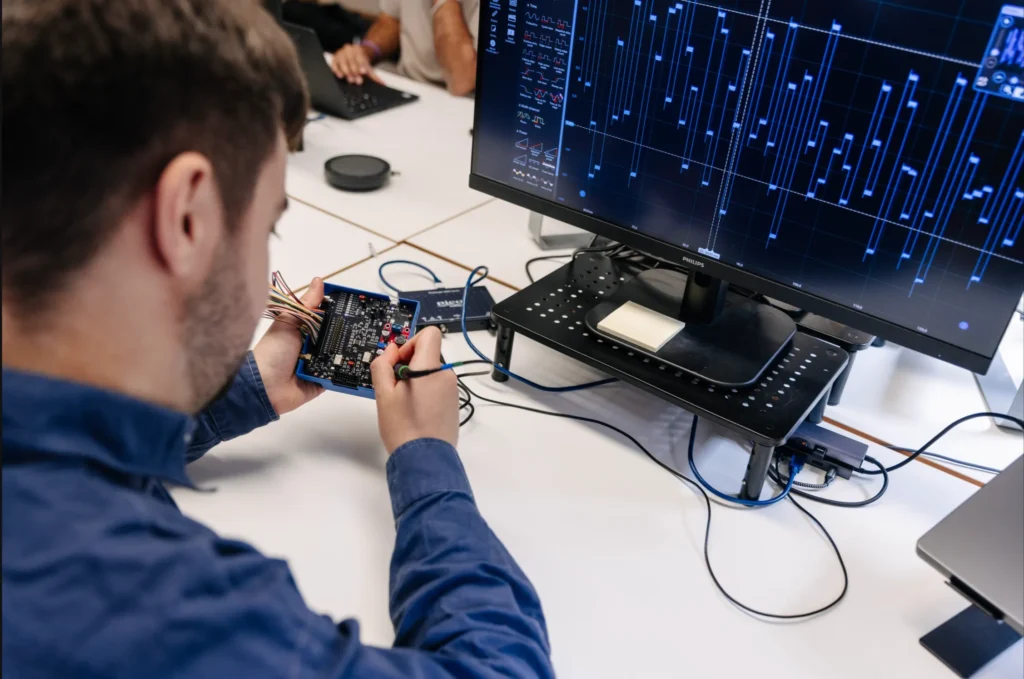
A focused research phase firstFour weeks of broadband signal capture and analysis high-bandwidth oscilloscopes, Python and MATLAB signal processing identified the modulation schemes, framing, and timing hidden in each analog signal.
An executable spec instead of a written oneBetter Devices built a software-defined-radio reference implementation that ingested real signal captures and output decoded, structured messages a single runnable source of truth every team could test against.
Three tracks in parallelWith the spec as the shared reference, hardware, firmware, and software development ran concurrently instead of in sequence software integrated against replayed captures before boards existed.
Integration as confirmationBecause every discipline built against the same decoded reality, system integration verified known behavior rather than discovering new problems.
The outcome
The client received a fully functional alpha embedded hardware and software four months after kickoff, compatible with more than fifty undocumented signaling schemes. When additional protocols appeared late in the program, the executable spec absorbed them in hours rather than triggering hardware revisions. The reference implementation remains in the client's toolchain as a regression suite for future product variants: the knowledge lives in code and captures, not in slides.