
The loop is closed. An agent writes, deploys, sees exactly what happens, and iterates. That visibility is why software teams ship in days.
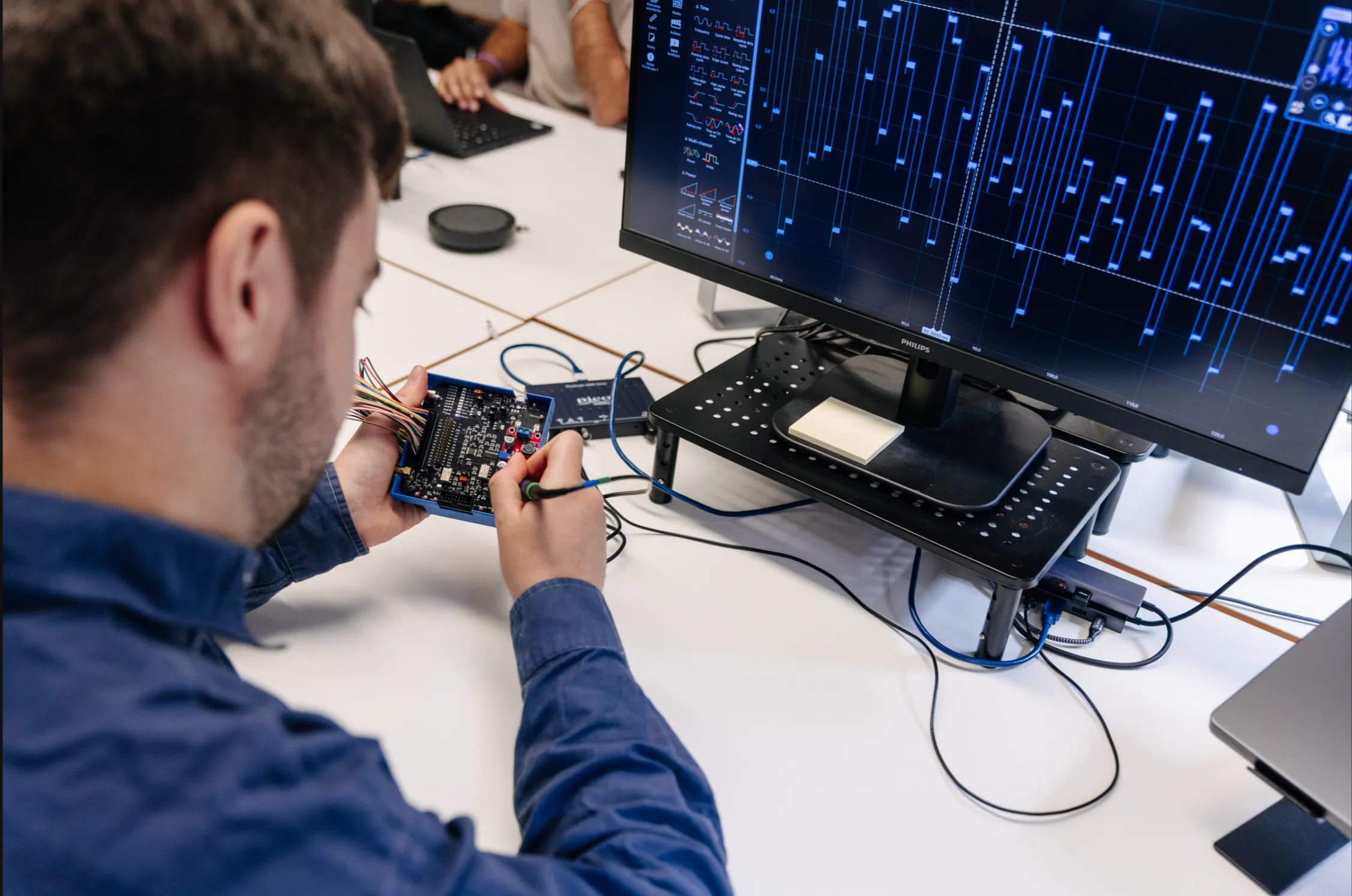
AI-enabled
hardware-in-the-loop
testing, on real hardware.
Validation that used to take months at the bench, done in a fraction of the time, with an engineer accountable for every result. The future of embedded testing starts here.
The slow part of shipping a device was never writing the firmware.
Development moves quickly. Validation does not. Tests remain serial, human-dependent, and constrained by the availability of the engineers running them.
Wiring a test rig by hand
Scoping a signal that only misbehaves under load
Reproducing a fault that appeared once in the field
Waiting for the one engineer who knows how the rig is cabled
Doing it all again when the pinout changes
Lead time to a working product is mostly lead time through the bench. Shorten that and the whole schedule moves.
Two loops
Software
Embedded
AI closed the software loop. Embedded is still waiting.
The same AI writes the firmware, but on real hardware it is blind. Testing falls back to a person with a scope, and the schedule falls back to weeks.
Synapsio closes that gap. It puts the bench in the loop, so testing on real hardware moves the way software testing already does.
The alternative
The same board, tested two ways
Manual bench testing
AI-enabled testing
When tests run
After development, when an engineer is free
On every build, alongside development
Setting up a test
Hand-wired. Redone for every revision
Declared once against the spec. Regenerated
What gets tested
What someone remembers to check
What the spec says to check. Every time
When a test fails
“It rebooted.” A week with a scope
A timestamp, a signal, a line of firmware
Regression after a fix
By hand, or skipped under pressure
Automatic and permanent
Where the knowledge lives
One engineer’s head
The spec and the run history
Time to validated firmware
Weeks, in series
Days, in parallel
The difference is not automation. One runs in series after development; one runs alongside it. That is where the lead time comes from.
Outcomes
Validation time is lead time, lead time is market position.
Three outcomes. One fundamental shift: validation no longer has to move at human speed.
Validation that keeps pace with development
Stimulus, capture and assertion against the spec, on real hardware, on every build. A fault introduced on Tuesday is found on Tuesday, not at the end of the sprint.
Lead time measured in days, not quarters
Validation runs in parallel, compressing development cycles and bringing EVT, DVT, and every milestone that follows closer to production.
Earlier to Market
The first product to ship reliably sets the reference. Shorter validation cycles put products in the field while others are still reproducing faults.
Featured case

Ran on a Better Devices board before anyone else’s.
14 days
to a verified board: firmware, bench and regression suite, on a known pinout
We used our AI-HIL platform to build its own hardware.
Before this was offered to a single client, Better Devices used Synapsio to bring up and validate the second revision of a developmental gateway. Firmware, bench and regression suite were done in fourteen days on a board with a known pinout.
The bench caught two faults that software-in-the-loop testing would have passed.
01
A DMA ring buffer losing one byte under bus contention
02
A rail sag crossing a logic threshold, found before layout freeze
Both found in the first week, not the field. The full case study has the numbers, the timeline with its caveats, and the name of the engineer who ran it.
Read the case study →Explore the Future of Device Validation
Synapsio is built and operated by Better Devices, embedded engineering consultancy, Berlin.